
Congratulations to World Cup champs Spain, who won one of the more exhausting-to-watch matches I can remember in any sport. Now back to baseball…
Buy
William Contreras, C, MIL
I’ve been a big Contreras booster, and his brother’s not too shabby either. The Brewers’ backstop was a massive value two seasons ago but hasn’t been the same since. Last year, he played through a fractured finger, and this year he seems to have tinkered with his approach with uneven results. He has brought up his launch angle, which has led to fewer grounders and more flies, while also cutting his swinging-strike rate. So, why isn’t he having a monster season? He isn’t hitting the ball quite as hard, and his homer-per-fly-ball rate has dropped down to 7.8%, which is just over half his career rate. However, his bat speed is unchanged, and some of the power issues we see on the stat page would evaporate if a few of his doubles off the wall had cleared the fence. I’m optimistic that he can put the pieces together for a strong finish.
Manny Machado, 3B, SDP
Machado spent the first half of the year looking like he had gotten old fast, but for the past month, he has gotten back to his regular self. It’s not just that his slash line of .263/.394/.553 since June 22 looks much more Manny-like, his barrel rate of 13.6% in that stretch provides good backup for those numbers. He’s been vague about whether he was playing through injury, but that seems likely given the polarized nature of his season. He will presumably cool off a little, but the recent version of Machado is much closer to the real one.
Nico Hoerner, 2B, CHC
I was a little down on Hoerner relative to the market prior to the season, mostly because I have a hard time spending a high pick on a hitter with no power. He generally gives you enough batting average and steals to make up for it, but this season the batting average has plummeted to the .240s, and the steals are a little off his regular pace. The good news is that his .258 BABIP looks unlucky, and Statcast thinks his batting average should be a more Hoerner-like .289. So he’s a buy, but there are a couple of caveats. One is that he now hits sixth in the batting order on most days after spending the first part of the year leading off, which will cost him some plate appearances and runs. The other is that his bat has been all the more noodle-like this season, with both his average and max exit velocity down a bit. You’re not rostering him for power, but you do need to get the ball past the infielders to get a hit, most of the time, and I wonder about his long-term viability if he can’t make better contact. The batting average and overall production should be better rest of season, but I’d sell in dynasty if you can get decent value.
Gavin Williams, SP, CLE
You don’t need me to tell you that Williams is good, but hey, he has an ERA of 4.00, and that could be frustrating for his managers. Last season, Williams’ ERA was 3.06, but underlying metrics suggested there was some good fortune mixed in there. This season it’s the opposite. His K-BB%, one of the best in-season predictors of future success, of 22.3% is eighth among qualified starters. His xFIP of 3.08 and SIERA of 3.22 back up that story. His problem has been home runs. His 18.3% HR/FB rate and 1.51 HR/9 would both be career highs. He might need a tweak in pitch mix in certain situations or just better luck. Either way, I expect ace-level production for the remaining balance of the year.
Sell
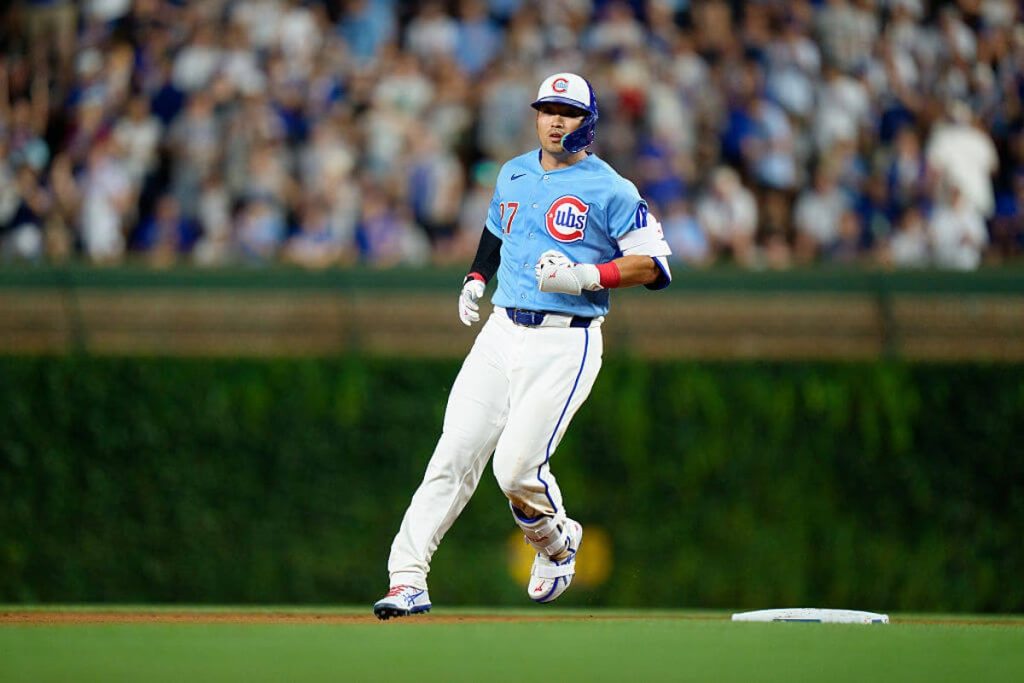
Seiya Suzuki, OF, CHC
On the surface this looks like a fairly typical Suzuki season. The average is down a little, but he’s walking more to make it up for it. The homers are still there, but that’s actually where my concern is. His barrel rate is down seven points to 9.4% and his exit velocity is down two ticks to 89.2 mph. His hardest hit ball of the season was 112.9 mph, which was well below last year’s max of 116.2. He has compensated with plenty of pulled flies, and the bat speed is the same, so there is reason for hope. I don’t think he’s about to fall apart, but the rest-of-the-season results may be closer to average than good.
Davis Martin, SP, CHW
I enjoy pitchers like Martin, who rely as much on deception and unpredictability as stuff. It can be a tough act to keep up, however, and recently there have been signs that things are slipping. Since June, Martin’s strikeout rate has dropped to 14.7%, while his walk rate has risen to 10.7%, from an ace-like 27% and 5.3% before June. The drop in his swinging-strike rate is equally stark — 13.1% before June 1, 8.5% after. I wouldn’t be surprised if he course-corrected enough to run a mid-4s ERA for the rest of the season, but with a 90 Stuff+ and 87 Pitching+, he won’t suddenly start blowing hitters away.
Michael McGreevy, SP, STL
McGreevy is having one of those charmed seasons that happens way too often in St. Louis. He never throws harder than 92 mph, strikes out between two and six hitters per game, usually gives up a home run, and yet in 19 starts, he has given up five runs twice, four runs once, three runs twice, and zero, one, or two the other 14 times. He is one of 15 qualified starters with an ERA under 3. He has done that by limiting walks and hits on contact, and stranding lots of runners. He has six pitches, all of which he throws between 11-25% of the time, and there is value in that approach that some stats don’t always pick up. The .255 BABIP looks unsustainable, but it’s worth noting that he is now 226 innings into a .267 BABIP career. As for the 83.5% strand rate, that definitely looks lucky, but it helps that the league is hitting .236 against him. All the ERA estimators and projections give him an ERA of 4.00+. Maybe he can magic that down to something in the high-3s, or maybe he does this for another two months and finishes one of the more baffling pitching seasons in recent memory. Sell unless you get this in a way that I don’t.
Hold
Kazuma Okamoto, 3B, TOR
Long-term, I’m excited about Okamoto. He has good raw power and a swing designed to maximize it. With a 14.3% barrel rate and a 46.8% hard-hit rate, I don’t need to see too much more, even with a K rate just north of 30%. For the rest of the season, my best guess is that what you see is what you get. Statcast thinks he’s been lucky on batting average (though, given his contact quality, I’m not sure why), but projection systems think he’ll stay in the .235-.245 range. His in-zone contact is near the bottom of the league, and he is whiffing much more than he did in Japan. A lot of that may be the change in competition, but I see some upside in his continuing to acclimate to the league.
Kyle Karros, 3B, COL
Karros has had a breakout year despite not having a standout tool. The power is average or a little better, the hit tool is good enough, the patience and eye are an asset, and the defense is good enough to hold down third base. He’ll have to find more bat speed to get to another level from here, but he’s a fine player as is. For fantasy purposes, he’s in the CI/UT range for 12-teamers, and you can raise him half a level in OBP leagues.
Keider Montero, SP/RP, DET
This one is league-dependent, because you won’t want to roster a multi-inning relief guy in every format. But where he fits, I actually like Montero a lot more in this role than as a starter. Since making the shift, his velocity is up a tick, he’s swapping out some changeups for sliders, which is helping him get more strikeouts, and his Stuff+ is up 10 points to 103. For fantasy purposes, he will help your ratios and get wins at a similar per-inning rate here. Those wins will be more luck dependent, but that’s fine, given the pitcher and team.