
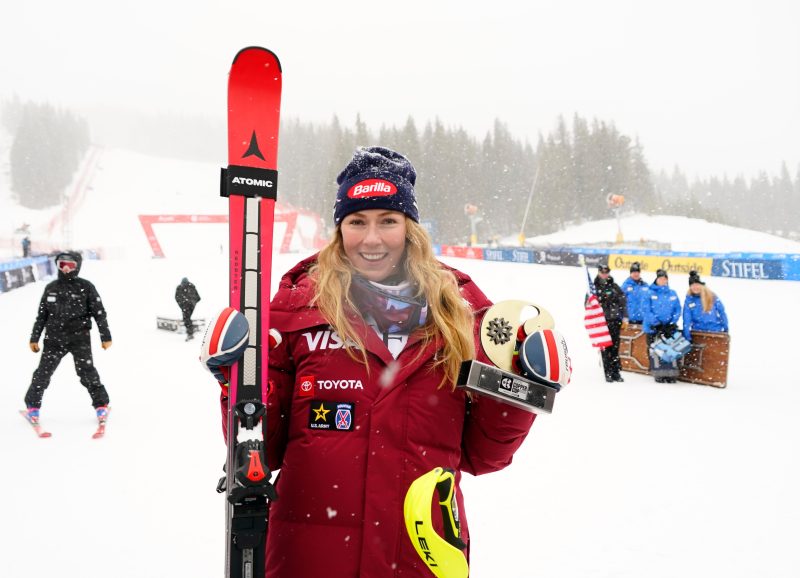
COPPER MOUNTAIN, Colo. — Mikaela Shiffrin’s skiing greatness doesn’t come from the wins or the records.
It comes from the quiet moments in training, when she’s obsessing over the tiniest of details and repeating a drill over and over to perfect her technique. Without those moments, the ones only her team sees, you wouldn’t get the big moments the whole world sees.
‘The attention to detail, that’s where she’s got it,’ Karin Harjo, Shiffrin’s head coach, said after Shiffrin won the slalom at Copper Mountain for her 104th World Cup victory.
‘What’s great is that she’s getting into this place, especially in slalom, where she’s really comfortable and she’s bringing the training scheme to racing,’ Harjo continued. ‘And that speed is something that I think for the world to see is great because it’s pushing the level of sport, showing what is possible, and I think that’s one of the coolest things that you can ever do.’
It may seem as if Shiffrin’s entire career has occurred in rarefied air. A World Cup winner at 17. The youngest to win the Olympic slalom. A five-time overall champion. A two-time Olympic gold medalist. Winner of a record 17 World Cups in a single season. Most World Cup wins of any skier, male or female.
But Shiffrin is human, and her current dominance came out of that frailty.
It was a year ago this weekend that Shiffrin suffered a puncture wound in her abdomen in a crash during the second run of the giant slalom at the World Cup in Killington, Vermont. She would miss the next two months of the season and, even after she returned, struggled with PTSD about the GS. Slalom was safer, but she was still fighting to regain her rhythm and momentum.
The offseason gave Shiffrin a chance to reset and immerse herself in the process, her favorite thing about skiing.
Some people ski for the medals or fame or money. Shiffrin skis for the joy she gets from making good turns and figuring out how to squeeze another tenth of a second or two out of herself.
‘I am so obsessed with the feeling that I get in between the start and the finish when it’s good,’ Shiffrin said Sunday. ‘It’s just such a beautiful feeling, and when I can improve that a little bit, that’s motivating. The second run was the motivating thing for me. And then to do it and to anticipate it, to visualize it and then to execute it and to actually get to the bottom and see that it was indeed well done, that’s the best feeling.’
That feeling feeds her confidence. And her confidence feeds her skiing.
She talked after the first run of being able to trust her slalom skiing. She hasn’t had a lot of time training slalom of late, but what she did have was solid and that allows her to trust that the work she’s put in will carry over onto the race course.
‘She’s found a place in which she can start to push again,’ said Paula Moltzan, who has been skiing with Shiffrin since they were teenagers.
‘I think after the crash in GS, she lacked confidence. She could clearly still win, but you just see that confidence coming back into her every turn, every race,’ Moltzan said. ‘That second run, the conditions are really tough, it’s a hometown crowd and she just handles everything with such grace. It’s pretty inspiring.’
The wins, the results — they just reinforce that it’s pushing herself in training that matters. It’s that constant challenge of making her turns just a tad quicker, just a bit tighter that’s her superpower.
‘Everybody talks about momentum, and really momentum is just an action or force that leads to the next step,’ Harjo said. ‘And so we’re always looking forward and taking the next step and working hard. Results in the past, both successful and not successful, happen. But we keep moving forward.’
Shiffrin is still trying to replicate what she’s doing in slalom in GS, which is no surprise given the trauma of last season. But she knows she is getting closer.
Though she finished 14th in the GS on Saturday, she was able to make adjustments from the first run to the second. After being 18th in the first run, she was 10th in the second, and was briefly atop the leaderboard.
‘It was another step,’ Harjo said. ‘I think sometimes people forget the mental side, how long it takes to come back from that. They have an expectation that she’s just going to dominate everything.’
Shiffrin isn’t worried about meeting other peoples’ expectations or even being back on the podium in GS or racing super-G. She is searching for that sweet spot in her training, because she knows once she finds it, it’ll be there on race day, too.
‘It’s going to just continue to take time,’ Shiffrin said. ‘But that’s a really motivating thing.’
Because it’s those little things that make her many, many great things possible.
Follow USA TODAY Sports columnist Nancy Armour on social media @nrarmour.